Am I Carrying Intergenerational Trauma and Resilience
Dear Dr. Faith, The older I get, the more I notice patterns in my family. We don't talk about pain. We survive it. My mother did what her mother taught her, and sometimes I hear myself saying or doing things I promised I would never repeat with my own children. I love my family and don't want to dishonor anyone, but how do I heal something that may have started before I was born?
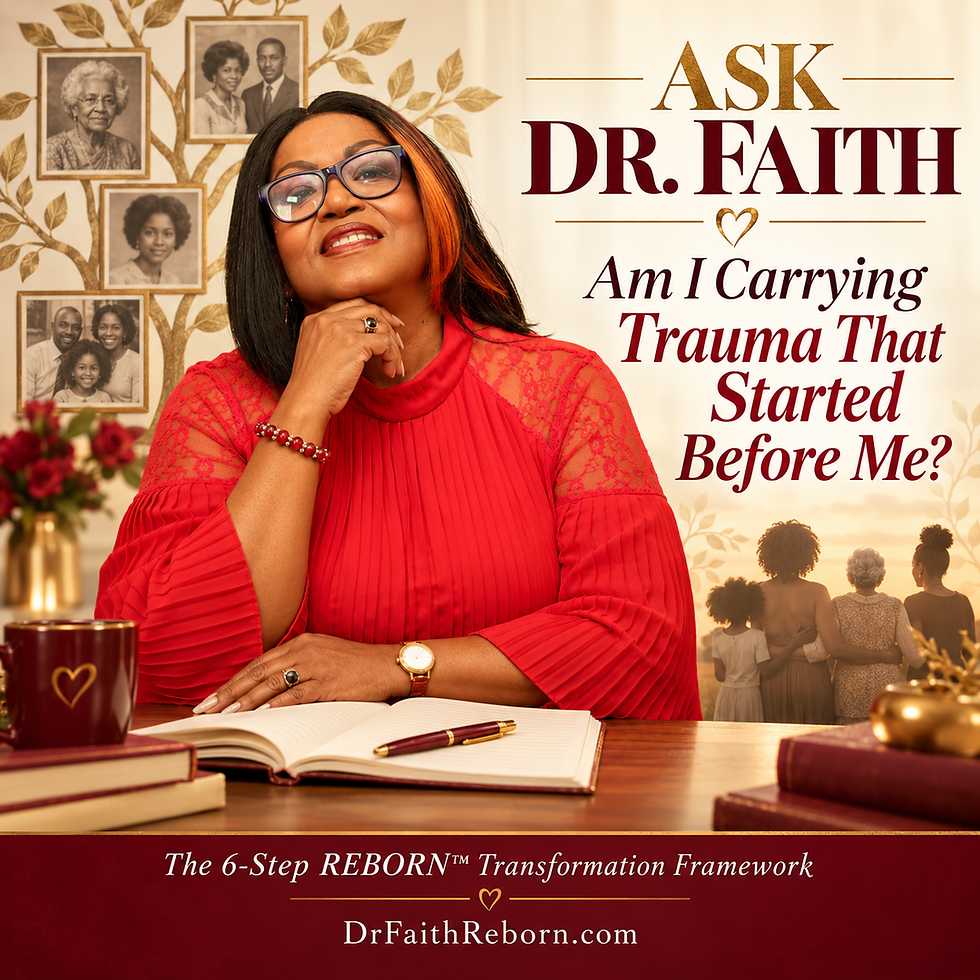
Dear one,
The fact that you can name this pattern with love already tells me something important: you are not trying to shame your family. You are trying to understand your inheritance.
That inheritance may include pain. It may include silence, emotional distance, harsh words, survival mode, fear of vulnerability, or the belief that rest is unsafe. It may also include prayer, humor, discipline, creativity, protection, endurance, storytelling, faith, food, music, caregiving, and the ability to keep going when life gave your family very little room to breathe.
Both can be true.
For many African American families, family patterns do not exist in a vacuum. They have been shaped by personal experiences and larger histories, including racism, loss, economic strain, community violence, medical mistreatment, and the pressure to appear “fine” in a world that has not always been safe. Recent research has looked at how traumatic exposure can move through family systems and interact with parental mental health, parenting, and children’s behavior. That matters, but it is not the whole story.
The story is not only inherited damage. It is also inherited resilience.
You are asking a sacred question: What do I carry, what do I heal, and what do I pass on?
Let’s walk through that question with compassion using the REBORN™ framework.
Recognize the pattern without assigning blame
When you hear yourself say something you promised never to say, it can feel like failure. It can feel like your mother’s voice came through your mouth before you had time to choose.
Pause there.
A repeated pattern is information, not a life sentence.
Recognizing does not mean blaming your mother, grandmother, father, aunties, uncles, or yourself. It means telling the truth gently enough that your nervous system can stay present.
You might recognize patterns such as:
Avoiding hard conversations until resentment builds
Using criticism as a form of correction
Treating rest as laziness
Expecting children to be “strong” instead of emotionally honest
Keeping family secrets to protect everyone’s image
Saying “I’m fine” when you are overwhelmed
Confusing obedience with connection
Believing love means sacrifice with no boundaries
Some of these behaviors may have caused harm. Some may still be causing harm. Naming that does not dishonor your family. Silence is not the same as honor.
Honor can sound like this:
“My people survived things they should never have had to survive. I can respect their strength and still choose a different way.”
That sentence leaves room for truth and tenderness.
Explore what the silence was trying to protect
Many families do not avoid pain because they are cold. They avoid pain because pain once felt dangerous.
A grandmother may not have had language for anxiety or depression. A father may have believed softness would make his children vulnerable. A mother may have learned that talking about family business invited judgment, punishment, or shame. An elder may have carried grief in the body because no one ever asked, “What happened to you?”
Survival strategies often begin as protection.
For example, “We don’t talk about pain” may have once meant:
We cannot afford to fall apart because everyone depends on us.
We do not trust outsiders with our family story.
We have to keep moving because rest does not pay the bills.
We were taught that emotions were weakness.
We had no safe place to put our grief.
That does not make every behavior acceptable. A survival strategy can outlive its usefulness. What protected one generation may pressure the next one.
This is where curiosity helps.
Instead of asking only, “Why are they like this?” try asking:
What might this behavior have helped someone survive?
What did my family have to hide in order to stay safe?
Who was allowed to cry, and who had to be strong?
What stories are repeated often?
What stories are never told?
What did love look like in my family when words were not available?
What strengths came through the same line that carried pain?
Exploring does not require you to interrogate relatives or force conversations they are not ready to have. Sometimes exploration begins privately. You notice. You write. You listen differently. You study your reactions. You trace patterns with care.
A journal can become a witness when family members cannot yet be one.
Breathe compassion into the story without excusing harm
Compassion is not the same as permission.
You can have compassion for what your mother endured and still name the ways her unhealed pain affected you. You can understand why your grandfather shut down emotionally and still grieve not being comforted. You can respect your family’s survival and still say, “This pattern stops with me.”
Take a slow breath as you read that.
This pattern stops with me.
Not because you are better than the ones who came before you. Because you have access to choices, language, support, and awareness that they may not have had.
This is part of transformation. REBORN™ does not ask you to erase your past. It invites you to come through it with new sight.
When old pain rises in parenting or relationships, the body may react before the mind catches up. You may raise your voice, shut down, become controlling, overexplain, or assume disrespect where there is only a child being a child. These reactions do not mean you are broken. They mean something in you is asking for attention.
Try this brief practice when you feel the old pattern activating:
Put both feet on the floor.
Take one slow breath in and a longer breath out.
Name what is happening in plain language.
Say quietly, “This is familiar, but I can choose.”
Take the next right step, even if it is small.
The next right step may be lowering your voice. It may be saying, “I need a minute.” It may be apologizing to your child. It may be calling a trusted friend before you send the text. It may be deciding not to debate with someone who is committed to misunderstanding you.
Compassion gives you enough space to choose.
Options for healing what began before you
Healing intergenerational patterns rarely happens through one big breakthrough. More often, it happens through repeated, ordinary acts of truth.
You practice a new sentence. You hold a boundary without overexplaining. You apologize faster. You stop joking about your pain. You let your children have feelings without punishing them for being human.
Here are several places to begin.
Write what you were taught and what you choose now
Journaling can help you separate inherited beliefs from chosen values.
Try completing these sentences:
In my family, pain was handled by...
In my family, anger was handled by...
In my family, children were expected to...
In my family, love was shown through...
One belief I inherited that no longer serves me is...
One strength I inherited that I want to keep is...
In my home, I want emotional safety to look like...
Do not rush your answers. Some truths arrive slowly.
Practice healthier communication in small moments
You do not have to start with the hardest conversation in the family. Begin where there is enough safety.
Instead of “You always do this,” practice:
“I felt hurt when that happened, and I want to talk about it differently.”
Instead of shutting down, try:
“I need a few minutes to calm down, but I do want to come back to this.”
Instead of pretending everything is fine, try:
“I’m not ready to share details, but I am having a hard day.”
These sentences may feel awkward at first. That is normal. New language often feels unnatural before it feels freeing.
Build new parenting and relationship patterns
If you are raising children, loving younger relatives, mentoring, or building a partnership, your healing can become visible in daily rhythms.
You might choose to:
Apologize when you overreact
Explain rules without humiliating
Let children ask respectful questions
Name emotions in the home
Create routines for rest, prayer, meals, or check-ins
Refuse to use fear as the main teaching tool
Show affection without making someone earn it
Let joy be part of your family culture
A powerful sentence for children is, “I am still learning too.” It does not weaken your authority. It models accountability.
Make room for spiritual reflection
For many families, faith has been a lifeline. Prayer, scripture, worship, meditation, ancestral reflection, and sacred community can help people hold grief and hope at the same time.
Spiritual reflection may sound like:
“God, help me see what I inherited clearly. Help me keep the wisdom and release the wound.”
Or:
“May I honor my ancestors by healing what they did not have the safety to heal.”
Spiritual care can be deeply supportive. If a spiritual setting tells you to ignore abuse, silence your needs, or stay in danger, that is not care. Seek support that protects your dignity and safety.
Consider qualified trauma-informed care
Some patterns need more than willpower. If family history includes abuse, neglect, violence, addiction, chronic fear, or deep grief, professional support can help you work with the body, mind, and story together.
A trauma-informed therapist understands that reactions often have roots. They should not shame you, stereotype your family, or pressure you to forgive before you are ready. Counseling can offer tools for emotional regulation, boundaries, parenting, grief, and relationship repair.
You deserve support that respects your culture, your faith if that matters to you, and your pace.
Reach out without forcing unsafe conversations
Safe conversations can be healing. Unsafe conversations can reopen wounds.
Before you talk with a family member, ask yourself:
Is this person able to listen without attacking or mocking me?
Am I seeking understanding, an apology, or permission?
What will I do if they deny my experience?
Can I stay grounded if they become defensive?
Do I need a therapist, pastor, support group, or trusted friend with me before or after?
A safe conversation might begin gently:
“I’ve been thinking about some family patterns. I’m not trying to blame anyone. I’m trying to understand myself better. Would you be open to talking about how our family handled pain?”
If the person cannot engage, that does not mean your healing stops. Some people will not be able to give you the conversation you long for. Grieve that honestly. Then keep choosing life.
Reach out to people who can hold truth with you. That may include a therapist, a support group, a faith leader with emotional maturity, a wise elder, or a friend who does not minimize your experience.
Next Step is choosing what stops and what continues
This week, do not try to heal the whole family line at once. Choose one pattern and one strength.
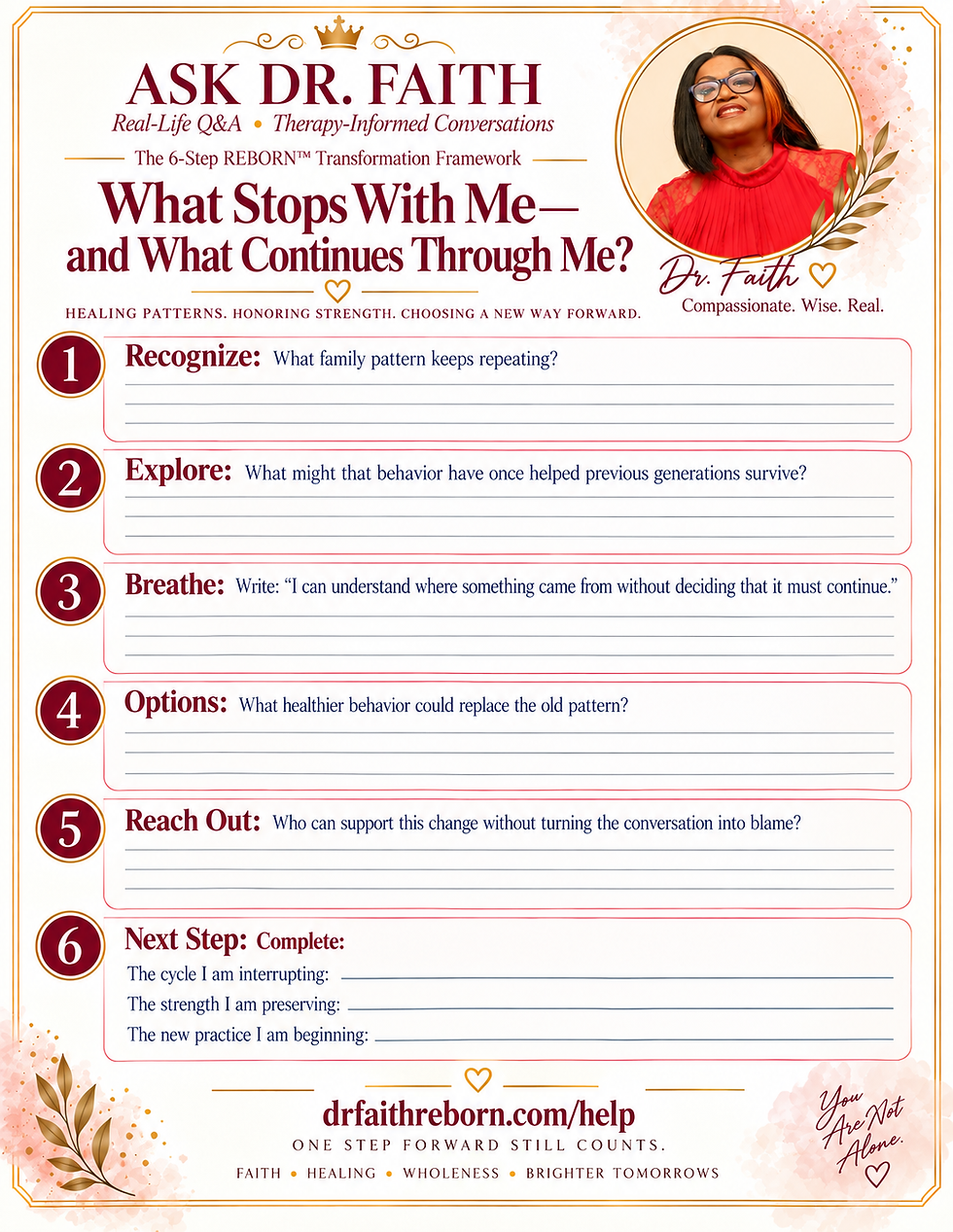
Use this REBORN™ Worksheet 5 prompt:
What Stops With Me and What Continues Through Me?
Recognize
What family pattern keeps repeating?
Write one clear sentence.
“This pattern keeps repeating in my family: ______.”
Explore
What might that behavior have once helped previous generations survive?
Write with compassion, not excuses.
“This may have helped them survive by ______.”
Breathe
What do I feel in my body when this pattern shows up?
Name it without judgment.
“When this happens, I notice ______.”
Options
What is one new response I can practice?
Keep it small and specific.
“Next time, I will ______.”
Reach Out
Who can support me as I practice this new response?
Choose someone safe.
“I can reach out to ______.”
Next Step
What strength do I want to preserve?
Do not throw away the gold with the grief.
“One strength I want to carry forward is ______.”
Maybe the pattern that stops with you is silence. Maybe the strength that continues through you is perseverance. Maybe fear stops, but faith continues. Maybe harshness stops, but discipline continues. Maybe secrecy stops, but loyalty continues. Maybe emotional distance stops, but devotion continues.
That is transformation.
That is being REBORN™.
Support for the healing journey
If this reflection brings up distress, please move gently. This article is for education and reflection. It is not a diagnosis or a substitute for mental health care.
If you feel at risk of harming yourself or someone else, or if you are in immediate danger, call 911 in the US or go to the nearest emergency room. You can also call or text 988 to reach the Suicide and Crisis Lifeline. If you are experiencing domestic violence, contact the National Domestic Violence Hotline at 1-800-799-7233 or visit thehotline.org when it is safe to do so.
For continued support, take one step today:
You are not dishonoring your family by healing. You are listening deeply to what came before you and deciding, with love and courage, what will come through you next.


Comments